
I hear these comments/questions from teachers all the time about students working in groups:
- What is the magic number of students for a group?
- How do I keep all of the students on task and working collaboratively?
- Heterogeneous or homogeneous grouping, what is the best way to group students?
- What do I do when one student takes over the group and quickly answers the task?
- How do I keep students thinking during a group activity?
Group engagement and successful collaboration among students in a group involves 5 key strategies. I will warn you that you must be diligent about these 5 strategies, this is not a ‘one and done’ type of effort. We must model and model and model some more to support students learning how to be active, cognitively engaged members of a group.
#1 and #2
Visibly Random Groups Working in Vertical Spaces
For the size and structure of a group, I am going to turn to the more recent research of Peter Lijedahl and Building Thinking Classrooms which can be applied to any K-12 classroom. Lijedahl (2020) connects group success with two easy-to-implement strategies: visibly grouping students randomly and vertical workspaces. Students should work in groups of 3 for grades 3-12 and groups of 2 for grades K-2. According to Lijedahl’s student interviews, students are willing to work in random groups if they know for sure the teacher didn’t stack the deck against them and secretly pick the groups. The students need to SEE the groups are being randomly selected. This can be accomplished with popsicle sticks, index cards, playing cards, a random number generator, and many other creative ways. We also need to change these visibly random groups every time we have students work in groups. Students have said they are willing to work with anyone for a class period but they wanted to know they would get to change groups the next time.
Vertical workspaces is another Building Thinking Classrooms practice that I have seen work in K-12 classrooms across the country. For lots of reasons, when students stand up to work on a task or activity and record their thinking on a non-permanent writing space, they think better and work together better. You don’t need to go out and buy expensive whiteboards to put around your room. Students can write on windows, chalkboards, whiteboard contact paper, and chart paper (although this is an expensive option). It takes about 5-6 weeks for students to really fall into a positive flow with these two strategies so keep modeling and keep doing them. I promise they work!
#3
Group Norms are a MUST!
We can’t ask students to exhibit certain behaviors if we don’t set norms for group work in our classroom. We can’t assume students know what a productive group looks like, sounds like, and feels like. Therefore we need to set group norms and model through a ‘fishbowl’ activity.
Fishbowl Activity:
- Ask 3 students to be a model group for you. Ask the students ahead of time so they don’t feel put on the spot.
- Ask the 3 students to model how they would sit or stand (see vertical spaces above) in their group. Would they all be standing? What if one student wants to sit? Is that OK? (No, it is not ok). Are their desks all facing each other or are they at the same table if they are sitting?
- Ask students what would happen if the following occurred in a group:
- What happens when the group first gets their task or activity?
- Who takes the lead?
- What if one student is doing all of the work?
- What if one student isn’t talking?
- What if we are all confused and don’t know what to do?
- While you are discussing these questions use the group of 3 to model these behaviors. You are building your classroom norms for group work. Make a list of the norms on chart paper to create an anchor chart of the norms. Refine the list to include no more than 4 norms. Post the norms in the classroom where everyone can see and reference them throughout the year.
- When students start to fall out of the norms do the fishbowl activity again with a selected group of students to model the norms.
Below are some great norms that you can incorporate into your own classroom. Remember to only pick 4 at most.
- Everyone is accountable for thinking and sharing their thinking with the group.
- Mistakes are expected, respected, and inspected.
- Asking for help from other students is collaboration and is encouraged.
- Thinking is more important than the answer.
- Everyone should be heard.
- Listen then talk.
#4
Student Accountability
A great way to encourage individual and group accountability is to use a rubric. Fisher and Frey (2020) in their Distance Learning Playbook discussed students’ cognitive engagement on a continuum. I have repurposed their ideas to create a group engagement continuum.
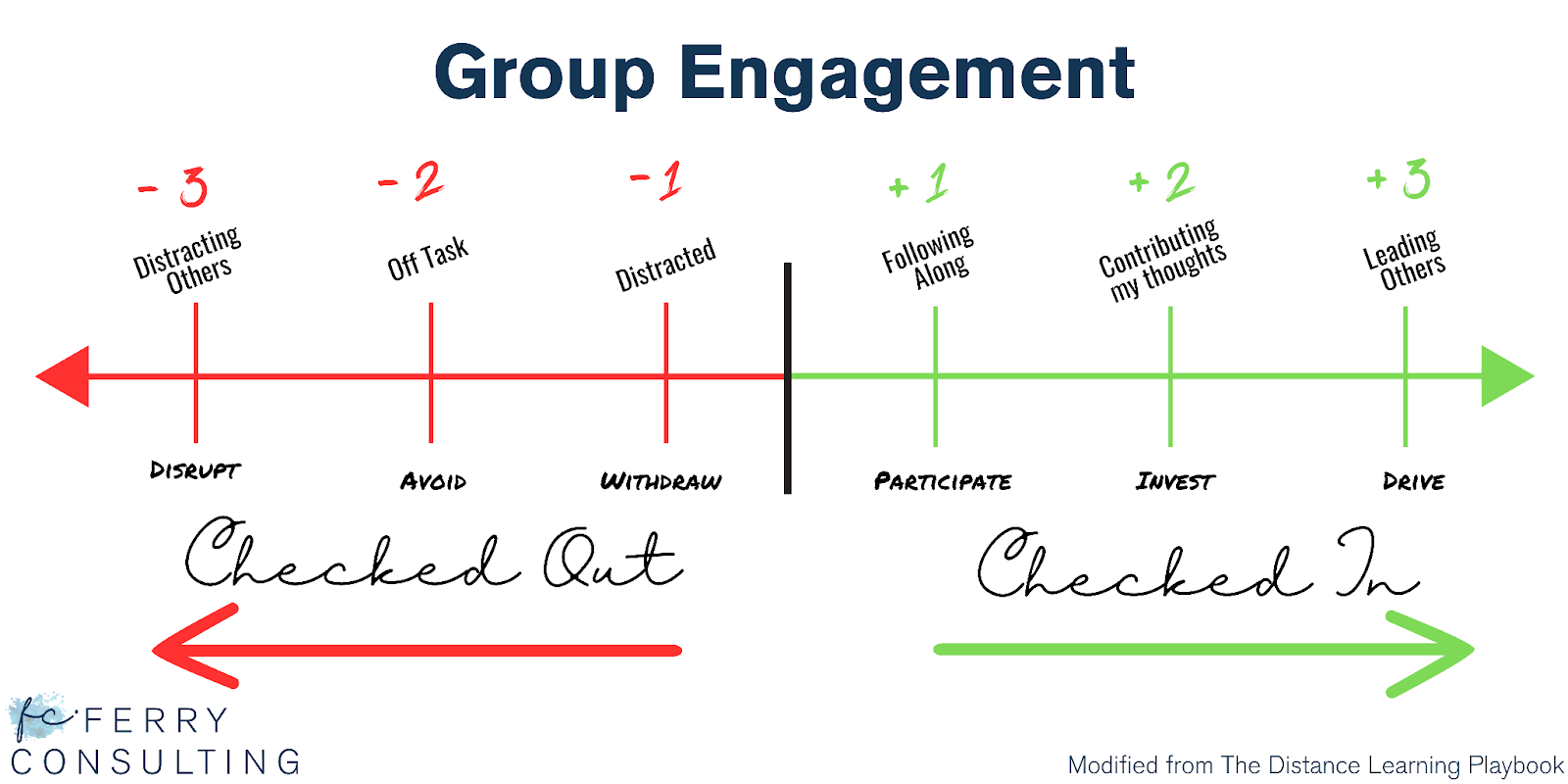
Use this continuum to set norms in your classroom, but also as a self-reflection tool for students. Ask them after each group task/activity where they would place themselves on the continuum and WHY. Ask students to place their whole group on the continuum and reflect on one action step they can take to be a better group. I will caution you not to use this as a way to give group participation points. Students should be given grades for what they know and understand, not how they behave.
#5
Make the group tasks THINKING TASKS
This may be the most important strategy you can employ for successful student groups. A thinking task is defined as a task or activity that supports the following criteria:
- There is more than one way to process the task. Think about looking around the room (vertical spaces) and seeing how your groups have used creativity and critical thinking to problem-solve through the task in a variety of ways.
- Students use content connections to process the task. Think about a task that asks students to synthesize information in a new and unique way using information and facts they may know.
- Thinking tasks can be related to new content if the new content is connected to prior learning. Don’t be afraid to give students a task just to see how they handle it. If you need to pull the class together to provide some support because groups are struggling, that is ok. Don’t pre-teach a thinking task because you assume the students won’t be able to do it.
- Debrief the task by asking groups of students to share their thinking and be amazed at the critical thinking they have been able to accomplish.
When we give students low cognitive demand tasks in groups we are just asking for mayhem. Students will rise to your expectations so set your expectations high.
Collaboration with peers is a life skill and employability skill that we have a responsibility to teach our students to do while they are in a safe space like your classroom.
Research Basis
Boaler, J. (2015). Mathematical mindsets: Unleashing students’ potential through creative math, inspiring messages, and innovative teaching. John Wiley & Sons.
Fisher, D., Frey, N., & Hattie, J. (2020). The distance learning playbook, grades K-12: Teaching for engagement and impact in any setting. Corwin Press.
Liljedahl, P. (2020). Building thinking classrooms in mathematics, grades K-12: 14 teaching practices for enhancing learning. Corwin Press.