
The first weeks of school are an exciting and energized time for students, parents and teachers. We want to maximize that small window to truly LAUNCH our classroom into a culture of learning, intrigue, wonder, curiosity, and idea sharing that will carry us through the whole year.
Ideas & Resources for the First Week of School
#1 Create classroom norms
One of the most impactful activities you can engage students in during the first week of school is Norm Setting. Classroom norms are NOT classroom rules. Instead,
Classroom Norms guide behavior, interactions, and routines within the classroom to ensure that everyone feels safe, respected, and able to focus on learning.
Please don’t spend the first day you have with your students going over grading policies, classroom rules, or procedures that can be boring, obtrusive, and just not fun! Rather, work collaboratively with your students to set norms that create a classroom culture of learning.
Setting Classroom Norms Protocol
- Place students into groups of 2 or 3 and ask them to generate a list of ideas/guidelines that would guide your classroom culture. While asking students to collaborate on ‘What makes classroom learning meaningful and fun,’ you are inviting them to have a voice in how their classroom is structured. We want students to feel they are all part of a classroom community.
- Once student groups have generated their lists, come together as a whole group and write the ideas on the board for all to see by asking groups to share their ideas. When you run across ideas that are similar or the same, don’t write those duplicates; instead, add a tally mark to those same ideas.
- At this point, you have a list generated on the board that is more norms than you will want for a classroom. The key number of norms is 4-5. Ask students to go back to their groups, taking the list of possible norms they have generated on the board, and combine or reword the norms to create a list of no more than 5. Their lists should honor all of the ideas on the board.
- As a whole group, ask the groups to share their 5 norms and, with your guidance and possible wording suggestions, develop a classroom list of 4-5 norms.
Sample Norms:
- Mistakes are respected, inspected, and reflected.
- Each student is responsible for the learning of all of us. Share your thinking.
- Respect each person’s thoughts, ideas, body, and feelings.
- Thinking together is more important than thinking alone.
- Actively listen to the person speaking. Listen before speaking.
Examples of classroom norms:
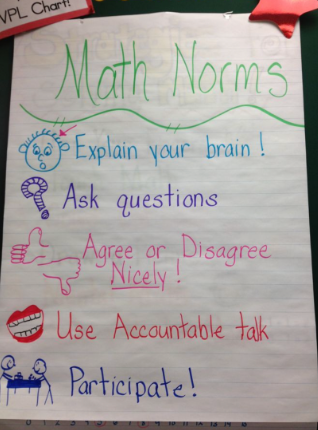
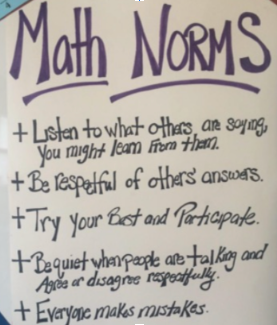
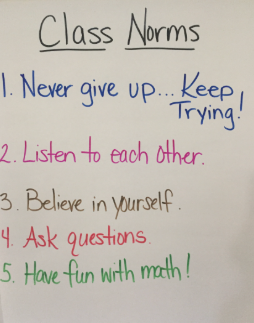
**Student-generated norms will vary depending on the age of the students. Your guidance will be more necessary for younger students. The key component is that the norms MUST come from the students.
#2 Introduce Vertical Spaces and Thinking Tasks
Students do their best thinking and learning while standing up! The research of Peter Liljedahl in his book Building Thinking Classrooms (2020) introduced the idea of vertical spaces. Many K-12 teachers have taken vertical spaces further by asking students to stand in groups and work on a task horizontally (at a desk or table). The key to increased student thinking and engagement is getting students out of their seats. By introducing this idea in the first week of school, you are setting a norm related to how students will work in your classroom.
What is a vertical space?
- A vertical space is defined as a space on a wall in the classroom or hallway that students can write on and erase.
- A Vertical Space can be an area on a chalkboard or whiteboard hanging on the wall. It can be a dry erase board (big or small) hanging on the wall. There are WIPEBOOKS or a piece of laminated 11 x 17 sheets of paper that can serve as a Vertical Space. Often, teachers think they need the fancy, expensive whiteboards in their rooms to implement Vertical Spaces, but that isn’t true. You can implement Vertical Spaces in your classroom at no cost!
Students should engage in a thinking task (non-routine task) at Vertical Spaces in randomly selected groups of 2 in grades K-2 and groups of 3 in grades 3-12. In the first few weeks of school, you will want to use Non-Curricular Thinking Tasks in your classroom to help students find their footing in these types of activities.
Non-Curricular Thinking Task Resources for grades K-12:
#3 Engage students in numeracy activities
One of the most impactful struggles students have in the classroom is numeracy (Number Sense). When students don’t understand how numbers work together, it can lead to a lack of fluency in math facts, ‘silly’ mistakes, and student frustration. The first 5 days are a great time to introduce Number Talks to your class.
Teacher Protocol for a Number Talk
- Utilize one of the numeracy resources listed below, place one ‘slide’ on the screen/board in your room.
- Ask students to turn to their shoulder partner (this is another activity you want students to begin to learn how to do) and discuss what they notice about the slide.
- After approximately 45 seconds to 1 minute (depending on age of students), ask one group of students to share what they noticed. As students share their ideas and generate new ideas from other students, before you know it, students are talking about numbers and the patterns and relationships in numbers.
- A Number Talk is NOT ABOUT THE ANSWER!. Refrain from providing instruction on how YOU would solve the problem or sharing what YOU see. A Number Talk is about students thinking, not teacher thinking.
- Do not turn the Number Talk into an opportunity to provide instruction. The point of the Number Talk is to get students talking about math!
Sample Number Talk – Grade 3

**Teacher puts this image on the screen
Teacher: Turn to a shoulder partner and share mathy things you notice about this image. You have 45 seconds to discuss your noticings. Be ready to share your thoughts.
Teacher: Sondra, can you share one mathy thing you and Julie discussed?
Sondra: We talked about how there are 4, then 5, then 6, then 5, then 4.
Teacher: Jack, what do you think Sondra and Julie are thinking about when they say 4, then 5, then 6, then 5, then 4?
Jack: Well, Matt and I noticed that each row goes up by one button, then back down by one button. I think that is what they are talking about.
Teacher: Jack, would you be willing to come up and show us what you mean?
**Jack comes to the front of the room and points to the number of buttons in each row.
Teacher: Alex, can you either add to what we have already talked about or share something you and your partner noticed?
Alex: We noticed that there were 7 buttons with yellow on them.
Teacher: Fantastic! Samanatha, what would you add to the discussion?
Samanatha: We noticed there were 24 buttons in the picture.
Teacher: Can you tell us how you know there are 24 buttons?
Samanatha: We took 9 plus 9 is 18, and added another 6 to it.
Teacher: Jeff, how do you think Samanatha and her partner got 24 buttons? Can you explain their thinking in your own words?
**This would continue for 5 minutes ONLY. Set a timer and stop the discussion. By setting a timer, you will leave the students wanting more. Number Talks are something you will want to add to the first 5 minutes of your classroom every day!
Check out my Grade Level Number Sense and Fluency Folders that are packed with resources from national experts.
Additional Number Talk/Numeracy Resources
- Steve Wyborney
- Everett Berkley – Math Flips
- Kristen Acosta – math in images (also try her Clothesline Math)
By starting your school year with these simple, yet impactful routines, you will build on the enthusiasm that always comes with the beginning of every new school year and set up your classrooms with a culture of inclusive learning.